Radiant barrier insulation is one of the most effective tools Norwalk, CA homeowners can use to fight back against a superheated attic. Bright Sky Attic Insulation, an insulation company serving Norwalk and surrounding communities, installs, upgrades, and removes radiant barrier systems for both residential and commercial properties, and its broader Attic Insulation services cover the full range of attic needs. If your upstairs rooms stay uncomfortably hot even after sundown, your air conditioner runs longer than it should, or your attic simply radiates heat into your living space all summer, a radiant barrier may be part of the right answer. This page explains what radiant barrier insulation is, how it works, what it costs, and how to decide whether it is the right next step for your home.
What is radiant barrier insulation?
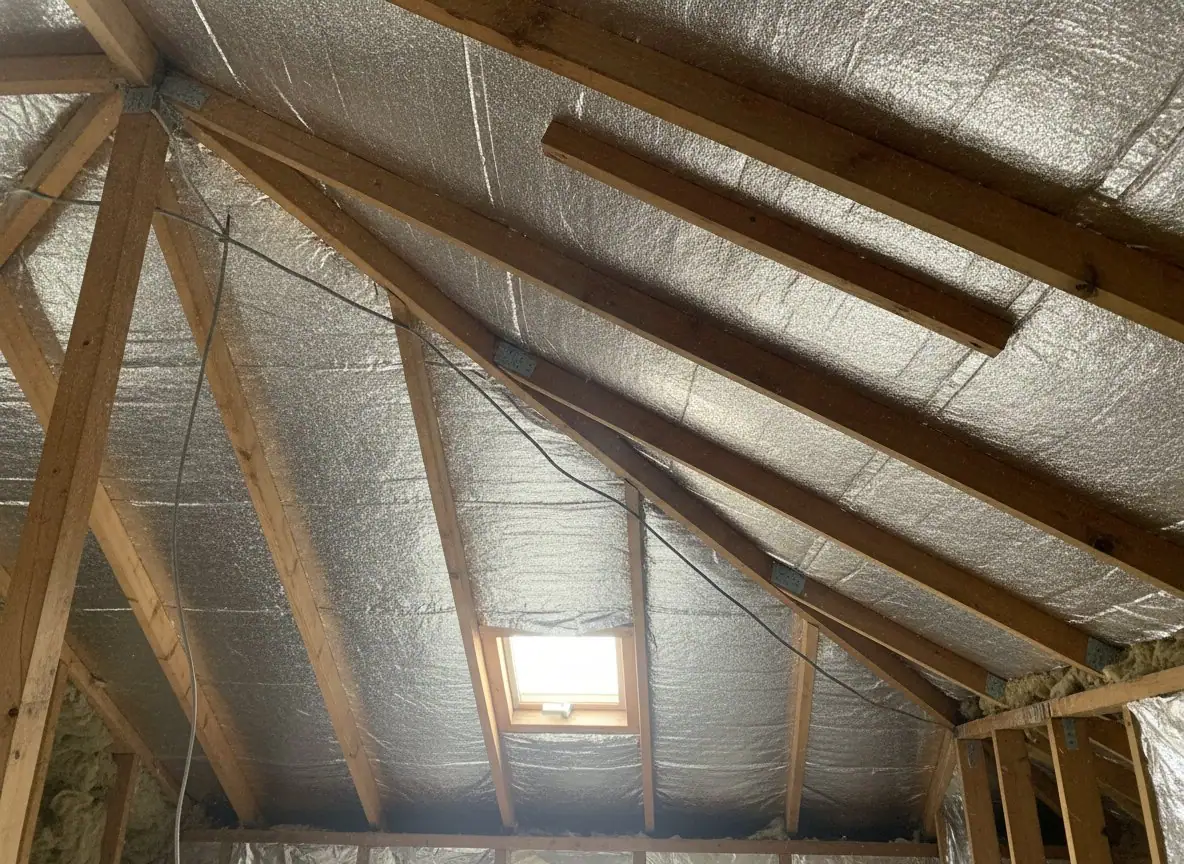
Radiant barrier insulation is a highly reflective material — most commonly thin aluminum foil — that reflects radiant heat rather than absorbing it. Heat travels three ways: conduction (through solid materials), convection (through air movement), and radiation (through electromagnetic waves). Traditional insulation materials like fiberglass batts and blown-in cellulose slow conduction and convection. A radiant barrier addresses the third mode: it reflects infrared radiation back toward its source instead of letting that energy pass into your attic and home.
The material is sometimes called attic foil, reflective insulation, foil insulation, or aluminum insulation. All of these terms describe the same basic principle: a surface with high reflectivity (typically 95% or higher) and low emissivity bounces radiant heat away. On a Southern California summer afternoon, when roof tiles can reach extreme temperatures, the underside of your roof deck radiates intense heat downward into the attic space. A radiant barrier mounted below that surface intercepts and reflects that energy before it reaches your insulation and living areas below.
Understanding what a radiant barrier is — and what it is not — matters before spending money on it, which is why the next question is how it actually performs inside an attic.
How does a radiant barrier work in an attic?
A radiant barrier works by positioning its reflective surface so it faces an open air space, allowing it to reflect radiant heat rather than conduct it. This air gap requirement is non-negotiable: foil pressed directly against another material conducts heat like any other surface and loses its reflective benefit entirely.
In Norwalk, CA and the broader Los Angeles basin, long, sunny summers mean roof decks absorb solar energy for many hours each day. That energy radiates downward from the roof sheathing into the attic air. A radiant barrier installed on the underside of the roof rafters or laid across attic floor joists reflects that energy back upward, reducing the temperature of the air in the attic cavity. A cooler attic means less heat is driven through your ceiling insulation and into your living space, and your air conditioning system works less to maintain comfort. To see how the layer between your attic and your rooms fits into this picture, our ceiling insulation page covers it in more detail.
Attic radiant barrier installation is especially valuable when HVAC ductwork runs through the attic. Hot attic air surrounding supply ducts forces the system to work harder. Lowering the attic temperature directly reduces energy waste at the duct level — a benefit that shows up on utility bills regardless of how much insulation is already on the attic floor.
One practical decision rule: if your attic air temperature at mid-afternoon is dramatically hotter than the outdoor temperature, your attic is absorbing more radiant heat than your current setup can handle, and a radiant barrier is worth evaluating. Knowing how the barrier performs sets the stage for the central question most homeowners ask next.
Free, no-obligation estimates
Talk to Bright Sky Attic Insulation
Tell us what you need and we’ll take it from there.
Is a radiant barrier worth it?
A radiant barrier is worth it in Norwalk, CA when your attic gets significantly hotter than the outdoor air, your existing insulation is thin, or your HVAC ducts run through the attic — but it delivers diminishing returns when heavy blown-in insulation is already in place. Opinions on radiant barriers are genuinely mixed, and both sides are right under different conditions.
Homes in Norwalk and nearby cities like Downey, Cerritos, and Bellflower were largely built in the postwar decades, often with shallow attic spaces and minimal original insulation. Many of these homes have been re-insulated over time, but ductwork added later is frequently routed through the attic without supplemental protection. For these situations, an attic radiant barrier installation reduces both radiant heat gain and the thermal load on ducts simultaneously.
Read moreShow less
Where attic insulation already exceeds R-38 or R-49 (the recommended levels for Southern California climates), the incremental benefit of adding a radiant barrier is smaller. The thick insulation layer is already slowing conductive heat transfer effectively, and the radiant barrier addresses a heat pathway that is already partially mitigated. In those cases, we evaluate whether air sealing or duct insulation would deliver more value per dollar spent.
The honest answer: a radiant barrier is not a universal solution, and that is exactly why we offer a free attic assessment before recommending it. Once you know whether a barrier fits your situation, the next step is understanding which product type is right.
At a glance
What types of radiant barrier and reflective insulation are available (foil rolls, perforated, foil-faced, bubble or foam-core)?
Four main product categories cover most radiant barrier and reflective insulation applications, each suited to different locations and performance goals.
| Product Type | Construction | Best Use | Moisture Handling | R-Value Added |
|---|---|---|---|---|
| Solid foil (single or double reflective) | One or two layers of aluminum foil, sometimes with a reinforcing scrim | Attic rafter stapling; large open areas | Blocks vapor — may trap moisture in humid climates | Minimal; works by reflection |
| Perforated foil | Aluminum foil with small holes punched through | Attic floors, humid climates, areas needing vapor permeability | Allows vapor to pass through | Minimal; works by reflection |
| Foil-faced (FSK) insulation | Foil facing bonded to fiberglass batt, rigid foam board, or duct wrap | Ducts, walls, roof decks, rigid insulation applications | Varies by substrate | Depends on substrate (e.g., foam board adds R-value) |
| Bubble or foam-core reflective rolls | Two foil layers sandwiching polyethylene bubble or foam core | Garages, sheds, small enclosed spaces; supplemental use | Moderate vapor resistance | Slight added R-value from core material |
Products sold at retail under brand names like Reflectix or Smart Shield are typically bubble-core rolls intended for small supplemental applications — not for whole-attic installation. Double reflective insulation and foil-faced insulation serve broader structural uses. Choosing the right product for a full attic installation is a step where material selection genuinely affects performance, which leads directly to how installation is actually done.
How is a radiant barrier installed in an attic, and how long does it take?
Attic radiant barrier installation follows a methodical sequence to ensure the reflective surface maintains the air gap it needs to function.
- Attic inspection: We assess the attic space for existing insulation depth, rafter pitch, ventilation condition, duct routing, and any moisture or rodent damage before specifying the right product and method.
- Ventilation verification: Proper attic ventilation is confirmed or improved. A radiant barrier traps heat differently depending on airflow — without adequate ventilation, attic temperatures can rise in some configurations.
- Surface preparation: We clear debris, address any existing insulation issues, and ensure rafter bays are accessible.
- Foil stapling or draping: Solid or perforated foil is stapled to the underside of the roof rafters (the most effective method for attic applications) or draped across attic floor joists over existing insulation where rafter access is impractical.
- Seaming and sealing: Foil panels are overlapped and taped at seams to prevent gaps. Gaps are where radiant heat bypasses the barrier entirely — this step is where quality installation separates from rushed work.
- Air gap confirmation: We confirm the reflective surface faces the open attic air space on at least one side.
- Final walkthrough: The completed installation is inspected for coverage, staple spacing, and consistent air gaps.
Read moreShow less
A standard residential attic in Norwalk typically takes one day to complete. Larger attics, unusually steep pitches, or attics with complex ductwork routing may require additional time. With the installation process clear, the next logical question is whether a barrier can be added on top of insulation that is already there.
Can you put a radiant barrier over insulation?
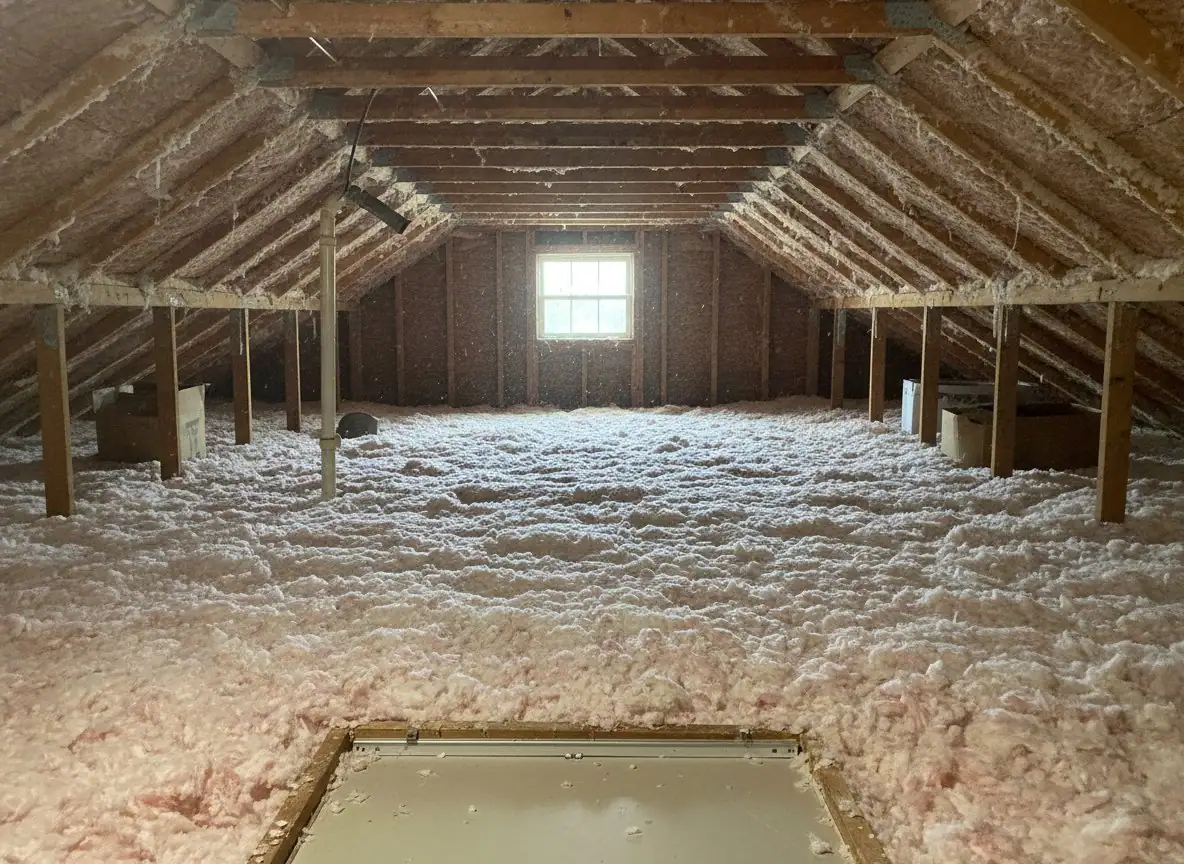
Yes, a radiant barrier can be placed over existing attic insulation by laying perforated foil across the attic floor joists on top of blown-in or batt insulation, but the rafter-staple method is generally more effective. When foil is placed on the attic floor, the reflective surface faces upward toward the hot attic air. This still reduces radiant heat transfer into the insulation below, but it also creates a surface that collects dust over time. Dust accumulation on the foil reduces reflectivity, which is a known limitation of floor-laid installations.
The rafter-staple method keeps the foil higher in the attic, where dust deposition is slower and the air gap to the roof deck is more consistent. If existing insulation is already deep (R-38 or more), adding a radiant barrier to the floor may deliver only marginal benefit. In that case, we typically recommend evaluating air sealing and duct insulation first. This brings up a comparison many homeowners ask about directly.
At a glance
Which is better, spray foam or radiant barrier?
Spray foam and radiant barriers solve different problems, and neither is universally better — the right choice depends on your attic's specific heat pathways.
| Factor | Radiant Barrier | Spray Foam Insulation | Blown-In Insulation |
|---|---|---|---|
| Heat type addressed | Radiant heat only | Conductive + convective + radiant (at roof deck) | Conductive + convective |
| Air sealing | None | Excellent (closed-cell) | Minimal unless combined with air sealing |
| R-value added | None (reflective, not resistive) | High (closed-cell: ~R-6/inch) | Moderate to high (cellulose: ~R-3.5/inch) |
| Best for ducts in attic | Yes — lowers ambient attic temp | Yes — conditioned attic encapsulation | No — ducts remain in hot attic |
| Moisture management | Varies by product type | Closed-cell blocks vapor; open-cell allows it | Vapor-permeable |
| Relative installed cost | Lower | Higher | Lower to moderate |
| Removal complexity | Straightforward | Difficult; a known reason homeowners switch away | Straightforward |
Spray foam applied to the underside of the roof deck creates a conditioned attic — ductwork is then inside the building envelope, which eliminates duct heat gain entirely. That is a more comprehensive solution but at a higher cost and with more permanent implications. Many Norwalk homeowners combine a radiant barrier with blown-in insulation upgrades to get meaningful improvement at moderate cost. Understanding the limits of each option leads naturally into the disadvantages worth knowing before you commit.
What are the disadvantages of using a radiant barrier?
Radiant barriers have real limitations that every homeowner should weigh before installation.
- Air gap is mandatory: Without a clear air space facing the reflective surface, the foil functions as a conductor, not a reflector. Poor installation eliminates the benefit entirely.
- Dust accumulation reduces performance: Foil laid horizontally (on the attic floor) collects dust over time. Dust on the surface raises emissivity, which reduces reflective efficiency. Rafter-mounted installations degrade more slowly.
- Moisture risk with solid foil: Solid (non-perforated) foil is a vapor barrier. In attics where moisture migrates upward from the living space, solid foil can trap moisture and promote condensation or mold if the ventilation system is not adequate. Perforated foil addresses this by allowing vapor to pass through.
- Limited benefit with heavy existing insulation: When attic floor insulation already meets or exceeds recommended R-values for Southern California, a radiant barrier adds less measurable benefit. The thick insulation layer already limits conductive heat gain, and radiant heat is only one of three heat transfer modes.
- No effect on air leakage: A radiant barrier does nothing to stop conditioned air from escaping through attic bypasses, recessed light fixtures, or duct leaks. Those are separate problems requiring air sealing or duct work.
- Not effective in cold weather: A radiant barrier's benefit is concentrated in hot, sunny conditions. In Southern California's mild winters, it provides no meaningful heating-season benefit.
Knowing these disadvantages allows for a realistic cost-benefit conversation, which brings up what most homeowners want to know next.
At a glance
How much does radiant barrier installation cost in Norwalk, CA?
Radiant barrier installation cost in Norwalk, CA is not a fixed number — it depends on a combination of factors specific to your home, and we provide a written quote after a free on-site attic inspection.
| Cost Factor | How It Affects Price |
|---|---|
| Attic square footage | Larger attics require more material and more labor hours |
| Rafter height and pitch | Steep or low-pitch roofs slow installation and increase labor |
| Access difficulty | Small hatch openings, obstructions, or cramped rafter bays add time |
| Product type selected | Perforated vs. solid, standard vs. foil-faced materials vary in material cost |
| Existing insulation condition | Damaged or contaminated insulation may require removal before installation |
| Ductwork complexity | Routing foil around or over ductwork adds time and material |
| Ventilation upgrades needed | Inadequate soffit or ridge venting may need correction before or alongside installation |
| Combination with other services | Pairing with blown-in insulation or air sealing may change total project cost |
Retail foil products sold at home improvement stores are priced per roll for DIY use and do not reflect the cost of professional whole-attic installation with proper seaming, ventilation assessment, and air gap verification. We offer financing options for homeowners who want to address multiple insulation needs at once, and we assist with insurance claims where insulation damage is covered. A free inspection is the only accurate starting point for understanding your actual cost.
How do you choose a radiant barrier installer, and what is the next step?
In Norwalk, CA, choosing the right radiant barrier installer starts with confirming that the company performs a physical attic assessment before recommending any product — not a phone estimate based on square footage alone. The attic's current insulation depth, ventilation status, duct configuration, and moisture history all affect whether a radiant barrier is the right solution and which product type fits your situation.
Questions worth asking any installer before hiring:
- Will you assess existing insulation and ventilation before recommending a radiant barrier?
- Will the foil be rafter-stapled or floor-laid, and why?
- Are you using perforated or solid foil, and what is the reasoning for my attic specifically?
- How will seams be sealed, and how will you confirm the air gap requirement is met?
- Is the quote written and itemized?
Read moreShow less
Bright Sky Attic Insulation provides free attic inspections for Norwalk homeowners and throughout our service area, which includes Pico Rivera, Bellflower, Artesia, Cerritos, Downey, La Mirada, Lakewood, Montebello, Paramount, Santa Fe Springs, Whittier, Buena Park, La Habra, and surrounding communities. We offer 24/7 emergency service, written estimates, financing, and insurance claim assistance as part of our insulation services in Norwalk, CA. Our trained technicians assess your full attic before recommending any insulation solution.
Call us at (562) 573-5138 or request your free attic inspection online to get a written recommendation for your specific home.
FAQ
FAQ
What is the disadvantage of foil insulation?
The main disadvantages of foil insulation are that it requires a facing air gap to work, solid foil can trap moisture vapor if ventilation is inadequate, and horizontal installations accumulate dust that reduces reflectivity over time. Foil insulation also adds no meaningful R-value on its own — it addresses radiant heat only, not conductive or convective heat transfer. In attics with already-thick insulation, the marginal benefit is small.
Why are people removing spray foam insulation?
Homeowners remove spray foam insulation for several reasons: some installations develop off-gassing odors if the product did not cure properly; closed-cell foam applied to roof decks can make it extremely difficult to inspect or repair roof sheathing; and spray foam removal is labor-intensive and costly if the product needs to be replaced or if moisture damage is discovered underneath it. Some homeowners also remove spray foam when transitioning to a different insulation strategy. For any of these situations, Bright Sky Attic Insulation provides insulation removal and replacement services, and our removal page explains how that work is handled.
Should I choose a solid or perforated radiant barrier?
Choose perforated radiant barrier foil for attic floor applications or in any space where moisture vapor needs to pass through the material. Solid foil is appropriate when it is rafter-stapled in a well-ventilated attic where vapor migration is not a concern, or where a vapor barrier function is intentionally desired. In Norwalk, CA and the surrounding Southern California region, attic humidity is generally lower than in coastal or humid climates, but we still assess each attic's ventilation before specifying solid versus perforated product.
Does a radiant barrier replace attic insulation?
No. A radiant barrier does not replace attic insulation. It addresses radiant heat transfer only. Fiberglass batts, blown-in cellulose, or spray foam are still needed to slow conductive and convective heat transfer. Radiant barriers and conventional insulation work best together: the barrier reduces the heat load reaching the insulation, and the insulation resists whatever heat does pass through.
Can radiant barrier be used in a garage or on ducts?
Yes. Radiant barriers are commonly used in garages using bubble-core or foam-core reflective rolls, which are easier to cut and install in finished wall and ceiling cavities. Foil-faced (FSK) insulation wraps are specifically designed for HVAC ductwork and reduce heat gain in ducts that run through hot attic spaces — a particularly relevant application for Norwalk homes where ductwork is routed through unconditioned attics. If you are looking at the garage itself, Bright Sky Attic Insulation installs both garage insulation and pipe and duct insulation as separate services.
Is radiant barrier worth it with existing blown-in insulation?
It depends on the depth of the blown-in insulation and whether ductwork runs through the attic. If existing blown-in insulation meets current R-value recommendations for Norwalk, CA and there is no attic ductwork, adding a radiant barrier delivers modest additional benefit. If blown-in insulation is thin (below R-30), or if HVAC ducts run through the attic, a radiant barrier can meaningfully reduce heat gain even when blown-in is already present. A free attic inspection is the most reliable way to answer this for your specific home — call Bright Sky Attic Insulation at (562) 573-5138 to schedule yours.
Why choose us
Why choose Bright Sky Attic Insulation?
Free estimates
Get a clear, no-obligation estimate before any work begins.
Licensed & insured
Your property and our crew are protected on every project.
Residential & commercial
One team for homes, multi-family and commercial properties.
Locally owned & operated
A local team serving your community and the surrounding area.
Get in touch
Find insulation help near you
Request a free estimate online or give us a call — our team will follow up quickly.
- Call us(562) 573-5138
- Visit14020 Pioneer Blvd K, Norwalk, CA 90650
- HoursMon-Sun 07:00-19:00